
Comprehensive Administrative Support for Interdisciplinary Research
An-Najah National University recognizes that interdisciplinary research is essential for addressing complex scientific and societal challenges. To foster innovation and excellence, the University provides structured administrative and technical support to enable researchers from diverse disciplines to collaborate effectively.
Key support mechanisms include clear research policies, access to modern infrastructure and laboratories, and platforms for collaboration, such as workshops, seminars, and interdisciplinary research committees. These systems are complemented by a flexible and adaptable administrative framework and strong leadership commitment to resources and infrastructure.

Core Structural Divisions of the Interdisciplinary Research Unit
The Interdisciplinary Research Unit (IRU) is strategically structured around four core divisions that work in an integrated and complementary manner to support interdisciplinary research across the University. This structure ensures that research teams receive comprehensive administrative, technical, and strategic assistance throughout the full research lifecycle — from idea development to international collaboration, innovation, and societal impact.
At the foundation of the IRU is the Research Development and Coordination Division, which serves as the central platform for fostering cross-disciplinary collaboration. This division actively connects researchers from different faculties, facilitates the formation of interdisciplinary teams, and supports the preparation of competitive research proposals. It provides guidance on funding opportunities, methodological design, and project planning, while also overseeing project monitoring and reporting processes. Through structured coordination and thematic research clusters, the division helps align interdisciplinary initiatives with institutional priorities and national development goals.
Research Development Staff:
- Interdisciplinary Research Coordinators (by thematic cluster):
- Health & Biomedical Sciences
- Engineering & Technology
- Environmental & Sustainability Sciences
- Social Sciences & Public Policy
- Grant Development Officers
- Proposal Writing Specialists
- Research Methodology Advisors

Complementing this function is the International Collaboration and Partnerships Unit, which expands the global reach of interdisciplinary research activities. This unit is responsible for building and sustaining strategic relationships with international universities, research centers, and global funding bodies. It supports joint proposals, research consortia participation, mobility programs, and collaborative supervision arrangements. By facilitating international agreements and ensuring compliance with global funding requirements, the unit strengthens the University’s international research presence and enhances opportunities for cross-border interdisciplinary engagement.
Staff:
- International Partnerships Officer
- Global Funding Liaison Officer
- Mobility & Exchange Coordinator
- International Agreements Administrator

To ensure that research outcomes translate into real-world impact, the Innovation, Technology Transfer, and Commercialization Unit plays a pivotal role in bridging academia and industry. This division supports intellectual property protection, patent filing, licensing procedures, and industry partnerships. It also encourages entrepreneurship by assisting in the development of research-based startups and spin-offs. Through impact assessment and commercialization pathways, the unit ensures that interdisciplinary research contributes not only to scientific advancement but also to economic development and societal well-being.
Staff:
- Intellectual Property Officer
- Industry Partnerships Manager
- Startup & Incubation Coordinator
- Research Impact Assessment Officer

Supporting all these functions is the Administrative and Operational Support Division, which provides the essential governance and management infrastructure required for effective research implementation. This division oversees financial administration, procurement, contracts, compliance procedures, and reporting systems. It ensures that interdisciplinary projects operate within a transparent, efficient, and accountable administrative framework. By streamlining processes and reducing bureaucratic barriers, the division allows researchers to focus on innovation and scientific excellence.
Administrative Staff:
- Financial & Grants Accountant
- Procurement & Contracts Officer
- Research Compliance Officer (Ethics & Governance)
- Data & Reporting Officer
- Administrative Assistants
Together, these four divisions form a cohesive and robust organizational framework that enables interdisciplinary research teams to thrive. Their integrated operation ensures strategic alignment, administrative efficiency, international engagement, and sustainable research impact, positioning the University as a dynamic hub for interdisciplinary scientific advancement.
Advisory & Strategic Oversight Layer
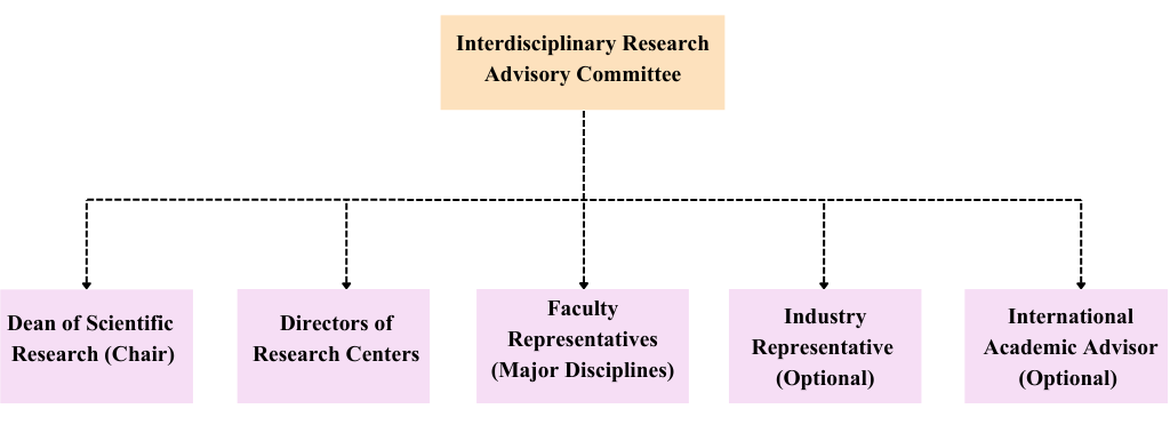
The Interdisciplinary Research Advisory Committee provides strategic guidance and high-level oversight to ensure that interdisciplinary research aligns with institutional priorities, national needs, and global research trends.
Composed of:
- Dean of Scientific Research (Chair)
- Directors of Research Centers
- Faculty Representatives from major disciplines
- External Industry Representative (optional)
- International Academic Advisor (optional)
Its primary goals are to:
- Ensure strategic alignment and effective resource allocation
- Maintain academic quality and research integrity
- Strengthen cross-faculty collaboration
- Enhance international competitiveness and research impact
Through this governance structure, the University ensures that interdisciplinary research is coordinated, accountable, and positioned for sustainable growth and global recognition.
Operational Model
The Interdisciplinary Research Unit organizes its activities around thematic research clusters, each designed to tackle complex scientific and societal challenges. Clusters may include areas such as Sustainable Energy, Public Health, Smart Cities, and Water & Food Security.
Each cluster has:
- Cluster Lead (Senior Researcher)
- Deputy Lead
- Project Teams (faculty + postdocs + PhD + research assistants)
-
Promote seamless collaboration across faculties and disciplines
-
Support efficient management and coordination of research projects
-
Enable interdisciplinary teams to deliver impactful, solution-oriented outcomes
-
Align research efforts with institutional priorities and societal needs
